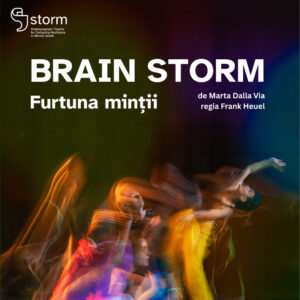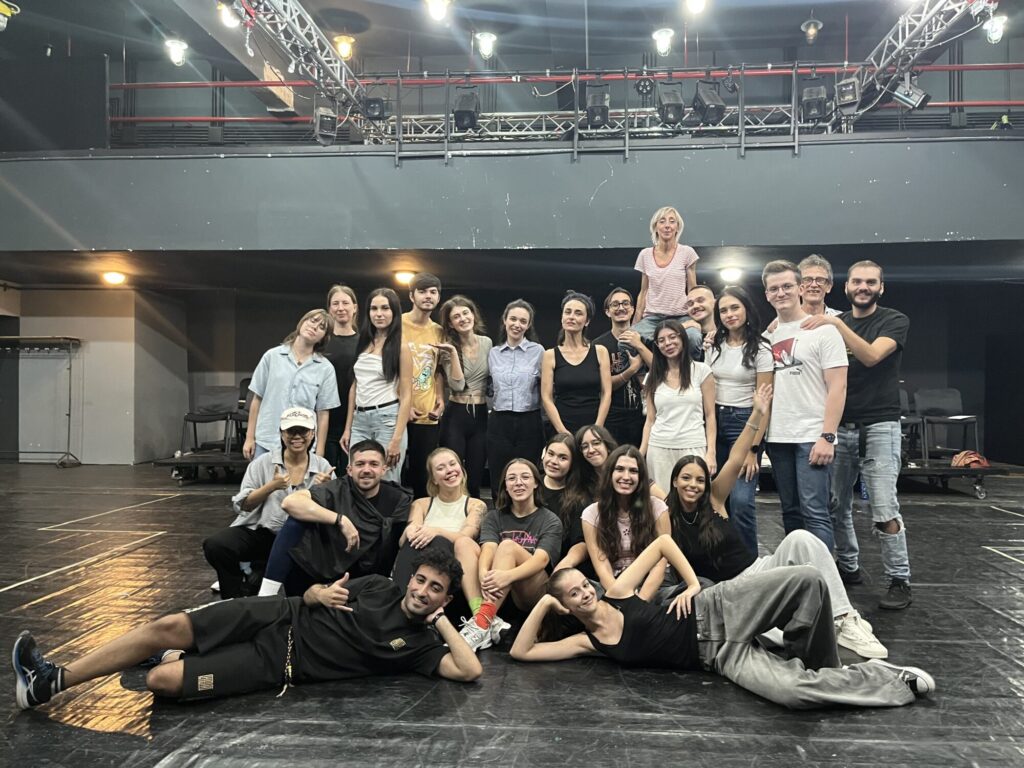
During the six days, the participants worked under the guidance of a multidisciplinary artistic team formed by Laurențiu Tudor – actor, director, producer (Romania), Frank Heuel – director (Germany), Annika Ley – set designer (Germany), Marta Dalla Via – playwright (Italy), Ovidiu Cârstea and Victoraș Matei – actors (Romania). The workshop combined acting exercises, dramatic writing, set and costume design, improvisation and text work with moments of reflection and group dialogue.
The workshop brought together participants aged between 18 and 25, from diverse educational and cultural backgrounds, in a collaborative and multidisciplinary working framework, which brought art, identity and mental health into dialogue. The workshop took shape as a safe and inclusive working space, in which young participants were supported to explore their own stories, emotions and fragility through theatrical means. Under the guidance of the STORM team, the young people worked with a series of creative tools – acting exercises, writing techniques, improvisation, text work, costumes and props and group exercises – which provided them with a concrete framework to explore their emotions and personal experiences. This safe medium of expression supported the process of articulating a series of personal narratives and contributed to the formation of a group dynamic based on trust, listening and dialogue.
The working process led to a first form of collective text, the result of dramatic writing exercises coordinated by Marta Dalla Via. The material reflects recurring themes in the group discussions and proposes a core of content that will be later developed in the final performance. This draft text will constitute the starting point for the final performance, and some of the young people will continue the STORM adventure as members of the cast or artistic team in the performances scheduled in Craiova, starting with 2026.
The work stage carried out in Craiova will have a correspondent in Italy, where the project continues with a new international workshop. The workshop organized in Padua will maintain the interdisciplinary and collaborative working direction, and will bring together other young participants around the same key themes: theater, identity and mental health.
The working week for STORM also included an online meeting of the team with psychologist Giuliano Tomei, designed as a moment of reflection on the workshop and the general dynamics of the group, aimed at strengthening the coherence of the process and supporting its continuity. During the workshop, the team was joined by Luisella Carnelli and Angela Mognol, evaluation experts from Fondazione Fitzcarraldo. Participants completed two anonymous questionnaires, at the beginning and end of the workshop, as part of an analysis exploring how co-creation processes contribute to group dynamics, emotional resilience and their personal development.
STORM – Shakespearean Theatre for Outlasting Resilience in Mental Health is a European project that investigates, through theatrical means, how Shakespeare’s texts can question essential themes today: mental health, resilience, identity and life in contemporary society. The Shakespearean universe – populated by characters in crisis, transformation or self-search – becomes the framework of a collaborative artistic process, coordinated by teams from Romania (National Theatre “Marin Sorescu” in Craiova), Germany (fringe ensemble) and Italy (Teatro Stabile del Veneto Carlo Goldoni, Fondazione Fitzcarraldo). The project brings together artists and specialists from complementary fields, in an interdisciplinary approach that uses theatre as a tool for critical expression and human reconnection.
The STORM – Shakespearean Theatre for Outlasting Resilience in Mental Health project is co-funded by the European Union through the Creative Europe programme. The opinions and views expressed are those of the authors and do not necessarily reflect the official position of the European Union or the European Executive Agency for Education and Culture (EACEA). The European Union and the EACEA do not assume responsibility for the content presented.